
Factory-Finished Where It Matters Most
Bathrooms are among the most coordination-heavy rooms in a home. They concentrate plumbing, ventilation, electrical service, waterproofing, fixtures, finishes, access requirements, and inspection risk in a small footprint. When that work is solved one project at a time, it creates delays, field rework, procurement complexity, and cost uncertainty.
Logic Bathroom Pods are being developed as factory-finished interior products for repeatable housing delivery. The finished bathroom interior arrives as a coordinated pod, while the surrounding exterior walls are handled according to their context: some walls sit against rated walls or adjacent pods, while other exposed exterior pod walls can be finished by the building contractor to match the surrounding dwelling unit.
Why Bathrooms Are the Right Place to Start
Bathrooms are service-dense, finish-sensitive, and expensive to correct after installation. A small mistake in layout, waterproofing, fixture coordination, exhaust routing, or drain/waste/vent planning can create disproportionate cost and schedule consequences.
That makes the bathroom a strong first product for Logic’s pod platform. By moving more of this complexity into a factory-finished product, Logic helps project teams reduce field decisions, improve finish consistency, and create a more predictable path from design to installation.
Configured, Not Custom
Logic’s product strategy is based on constrained choice. Bathroom Pods should eventually allow customers and project teams to select from defined options such as tub or shower arrangement, finish palette, fixture package, vanity and storage configuration, and other controlled product choices.
The goal is not infinite customization. The goal is a product family that gives customers meaningful choices while preserving the repeatability needed for faster delivery, more predictable pricing, and better installation planning.
Designed to Work with the Logic Coupler
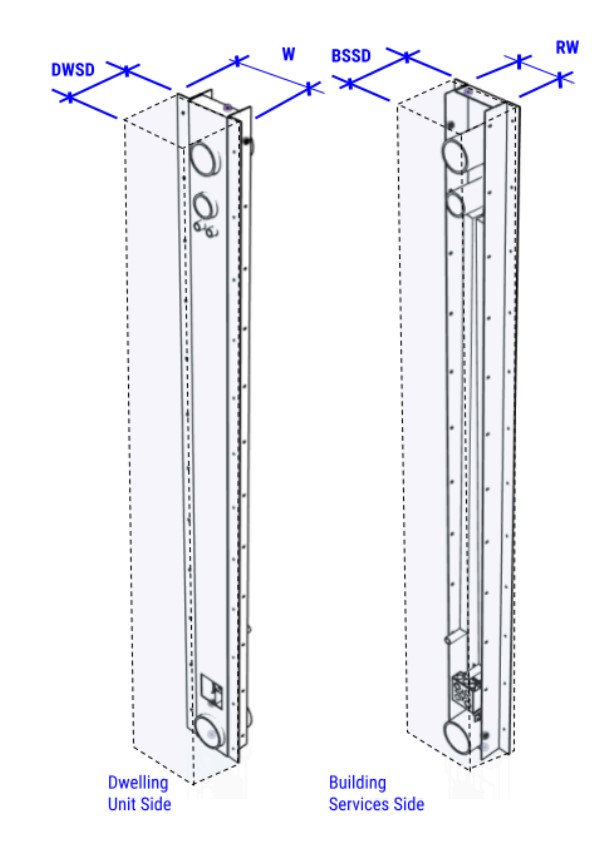
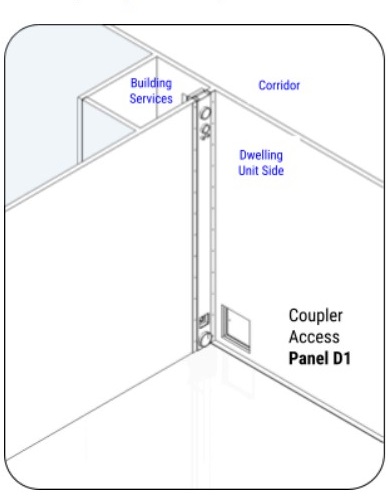
In a typical Logic bath deployment, the pod is organized so its service wall sits within a few inches of the Logic Coupler, allowing plumbing, exhaust, and electrical service to be coordinated through a planned interface rather than solved across the finished dwelling unit.
That interface relationship is central to Logic’s approach. The Bathroom Pod contains and organizes the service-intensive room. The Coupler helps concentrate connection, access, inspection, and verification work at a planned location. Together, they help reduce the need for skilled trades to solve one-off connection problems deep inside the dwelling unit.
What It Helps Reduce
Bathroom Pods support lower-cost, more predictable delivery by reducing coordination time, field labor, procurement complexity, and rework risk. Instead of managing many separate parts, trades, inspections, and sequencing problems across each bathroom, project teams can begin to work with a repeatable product and a clearer installation pathway.
That benefits developers, contractors, manufacturers, and residents. Developers gain more predictable cost and schedule assumptions. Contractors gain a simpler installation scope. Manufacturers gain a more repeatable production target. Residents gain a finished bathroom experience shaped by quality control rather than field improvisation.
Development Status
Logic’s Bathroom Pod is in a pilot-ready design direction, supported by a physical prototype and an advancing Autodesk Fusion digital twin. The product is being refined for early deployment, showroom demonstration, and integration with Logic’s broader pod, panel, coupler, and configurator strategy.
The 802 Homes effort is one early pathway for learning how Bathroom Pods can support repeatable single-family housing delivery. Logic is using this stage to refine product assumptions, installation logic, configuration constraints, and customer-facing options before broader product launch.
Discuss a Project
Logic is currently speaking with housing teams, developers, manufacturers, and project partners interested in pod-based delivery, interface coordination, and the future of configure-to-order housing commerce.